
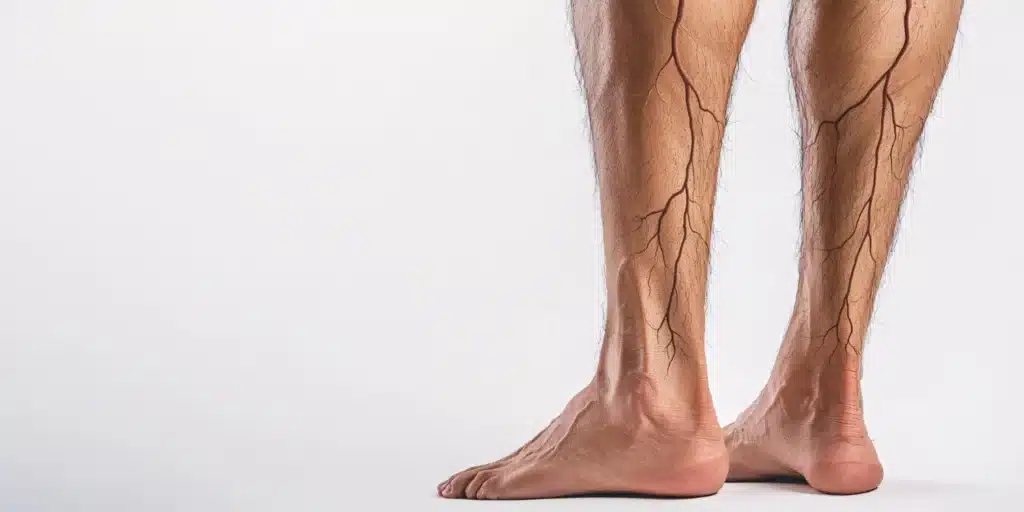
If your legs feel heavy, achy, and swollen by the end of the day, you have probably told yourself the same thing most people do. You were on your feet too long. You are getting older. It is just how your legs are now.
For a lot of people, that explanation holds for months. Sometimes years. The discomfort becomes background noise, something to manage rather than something to investigate. But in many cases, those symptoms are not random tiredness or a normal part of aging. They are the body’s way of flagging a vascular problem that has a name, a cause, and a treatment.
Varicose veins are one of the most underreported conditions in vascular medicine. Not because people do not have symptoms, but because the symptoms are so easy to rationalize away. This article is about learning to recognize those symptoms for what they are, and understanding when it is worth getting them checked out.
What Is Actually Happening Inside the Vein
To understand why varicose veins cause the symptoms they do, it helps to understand the basic mechanics.
Your leg veins have a difficult job. Unlike arteries, which are pushed along by the force of the heartbeat, veins have to move blood upward against gravity, all the way back up to the heart. They do this with the help of tiny one-way valves that open to let blood through and close to stop it from sliding back down.
When those valves weaken or stop working properly, blood does not move forward the way it should. It pools. Pressure builds inside the vein. The vein walls stretch and expand under that pressure. Over time, the veins become enlarged, twisted, and visible beneath the skin.
But the visible veins are only part of the story. The pooling blood and increased pressure affect how your legs feel throughout the day, often long before the veins become obviously visible. That feeling in your legs at 4 in the afternoon is not imaginary. It is a real physiological response to venous insufficiency.
The Symptoms People Most Often Miss
Legs That Feel Heavy by Afternoon
This is the most common symptom and the one most frequently dismissed. It is not the sharp pain of an injury or the burning of a muscle problem. It is a dull, dragging heaviness that builds as the day goes on and eases when you lie down or put your feet up.
That pattern is the tell. The heaviness gets worse as the day progresses because blood has been pooling with gravity all day. It improves overnight because lying flat removes the gravitational pressure that has been building in the veins for hours. If your legs feel noticeably better in the morning and noticeably worse by evening, that cycle is worth paying attention to.
Aching or Throbbing After Standing or Sitting
Many people with venous disease describe a persistent aching or throbbing in the calves or thighs, particularly after long periods of standing at work or sitting on a long drive. The discomfort is not constant. It comes and goes in relation to activity and position, which is why it can feel difficult to pin down.
This kind of positional aching is a hallmark of venous insufficiency. The valves that should be pushing blood upward are not doing their job efficiently, so blood pools in the lower leg veins during extended periods of standing or sitting, and pressure builds until you move or rest.
Swelling That Appears by Evening and Is Gone by Morning
Mild swelling around the ankles and lower calves that appears through the day and settles overnight is one of the clearest physical signs of venous disease. It is caused by the same pressure buildup that drives the heaviness and aching. As fluid leaks from the engorged veins into surrounding tissue, the ankles and lower legs swell visibly.
A lot of people notice this swelling but attribute it to the heat, to salt intake, or to standing too long. All of those things can cause mild swelling on their own. But if the swelling is consistent, if it appears reliably in the evening and disappears overnight, venous insufficiency is a very likely cause.
Night Cramps and Restless Legs
Cramping in the calves during the night, or that restless, uncomfortable sensation that makes it hard to settle the legs at bedtime, is frequently linked to underlying venous disease. Many patients who eventually seek varicose vein treatment in Houston report that they had been managing disturbed sleep for months or years before connecting it to their vein health.
The mechanism is not fully understood, but it is thought to relate to the metabolic byproducts that accumulate in the leg tissue when venous return is poor. The legs are not clearing properly overnight, and the result is cramping and discomfort that can significantly affect sleep quality.
Itching or Irritated Skin Around the Vein
An itchy, irritated sensation around visible veins or along the inner calf is another symptom that rarely gets connected to venous disease. It tends to come and go, and it is easy to attribute to dry skin or mild dermatitis. But persistent itching in the lower leg, particularly if it follows the path of a vein, can be a sign that venous pressure is affecting the surrounding skin tissue.
Skin Changes Around the Ankle
This is the symptom that tends to appear in more advanced venous disease. Skin around the ankles and lower calf that darkens, thickens, or takes on a leathery texture is a sign that venous pressure has been elevated for long enough to cause changes in the tissue itself. The medical term is lipodermatosclerosis. It is a signal that the venous disease has progressed and that early intervention would have been worthwhile.
Why Varicose Veins Get Worse Over Time
Venous disease is progressive. The valves do not repair themselves, and the pressure inside the affected veins does not reduce on its own. Without treatment, the symptoms typically worsen gradually. Walking distance may decrease. Swelling may become more persistent. Skin changes may develop. In advanced cases, venous ulcers can form on the lower leg, wounds that are difficult to heal precisely because the underlying circulation problem has not been addressed.
This is not meant to cause alarm. Most people with varicose veins manage their symptoms for years without developing serious complications. But it is worth understanding that the condition is not one that stabilizes without intervention. The earlier the underlying venous insufficiency is treated, the simpler the treatment tends to be.
When the Symptoms Are Worth Investigating
There is no single threshold that tells you when to seek help. But there are some clear signs that a professional evaluation is the right next step.
If your legs feel heavy or ache most days. If swelling is appearing regularly by the end of the day. If your sleep is being disrupted by cramps. If you have noticed any skin changes around the ankle. If the symptoms are starting to affect how you move, work, or go about your day. Any of these, on their own or together, are enough reason to get a vascular assessment.
The good news is that varicose veins Houston residents are dealing with are highly treatable. Modern minimally invasive techniques close the diseased vein from the inside through a pinhole, redirect blood naturally to healthy veins, and allow most patients to return to normal activity the same day. There is no surgical stripping, no hospital stay, and no general anesthesia.
Not Sure If Your Symptoms Match?
If you are reading this and recognizing some of what is described but are not certain whether your legs are pointing to venous disease or something else, the Treatment Finder at legpainclinic.com/vein-disease/ is a good starting point. It walks you through your symptoms in a few quick questions and connects you with Dr. Anwer’s team if venous disease looks like a likely match.
Getting Evaluated in Houston
Dr. Bilal Anwer is a Stanford Fellowship trained and CAQ Board Certified Vascular and Interventional Radiologist with over 10 years of experience treating venous disease at Leg Pain and Vascular Institute. He reviews every patient’s ultrasound imaging personally before recommending any treatment, and consultations are thorough and unhurried.
If you are looking for a varicose vein doctor Houston TX, no referral is needed to book an appointment. Most major insurance plans are accepted, including Medicare. Same-week appointments are available at both the Houston FM 1960 and Webster locations.
If your legs have been trying to tell you something, this is a straightforward way to find out whether they are right.